How to Check Hashtag Popularity (and What the Post Count Hides)
Where to find a hashtag's post count, what that number leaves out, and how to judge a tag's size, activity and risk, with data from 553,656 hashtags.

The short version of how to check hashtag popularity: look up the tag’s post count, in Instagram’s search or in a hashtag tool that reads it for you. That number is a running total going back years, so also check what it can’t show you: whether people still use the tag, who dominates it, and whether Instagram has restricted it.
The rest of this article is about reading the number properly, because it’s less useful than it looks. #reels and #fashion both have more than 1.2 billion posts, but #reels gains about 28 times as many new ones a day. #photooftheday is shrinking. And #love’s count stopped at exactly 2,147,483,647, the biggest number Instagram’s counter can hold.
The figures come from the MetaHashtags database in October 2026: 553,656 hashtags, each with the post count Instagram’s own tag search returns. Where I describe Instagram’s app, I’ll say what Instagram documents and what it doesn’t, because many of the guides ranking for this were written for an older Instagram.
What “hashtag popularity” actually means
Tools and guides tend to treat popularity as a single number. It’s really four questions, and the post count answers only the first.
- How big is it? The post count. Good for sorting tags by size, and that’s about it.
- Is it still in use? How many new posts arrive each day. Two tags with the same total can be busy or close to dead.
- Who’s at the top? Instagram orders hashtag results partly by engagement, so a tag whose top posts come from very large accounts is hard for a small one to break into.
- Is it restricted? A hashtag Instagram has restricted may not come up in search at all, whatever its count says.
Instagram removed hashtag following (announced in November 2024), so there’s no follower count to go by, and the post count is the main public number left. Before any of this, ask whether the tag describes this post.
How to check hashtag popularity on Instagram
In the Instagram app
The app is free and it’s the original source of the number, but it’s one tag at a time, with no history. The basic route:
- Open Instagram’s search.
- Type the hashtag you want to check.
- Find the hashtag in the results. Many guides describe a Tags tab that lists matching hashtags with a post count beside each; look for it in your version of the app.
- Tap the hashtag to open its hashtag page, and scroll through the posts.
Instagram’s Help Center describes that as “a page that shows all photos and videos people have uploaded with that hashtag.” Public ones, anyway: “When people with private profiles tag posts, they won’t appear publicly on hashtag pages.”
With a hashtag tool
The app is fine for one tag. When you’re choosing five from fifteen candidates, you want exact counts side by side, from the same day.
That’s what our generator does. Type a hashtag or describe your post, and it returns related hashtags with live Instagram post counts, a size label on each, and a flag on any that are on our restricted list. The counts are the number Instagram’s own tag search returns for each hashtag, not estimates.
Why two counts for the same tag might not match
- Timing. #viral has averaged about a million new posts a day since April 2025 (roughly 13 a second), so yesterday’s count is already a million behind.
- Freshness. A tool’s count is only as current as its last fetch. Look for a date, and check one tag by hand before trusting any tool, ours included.
- Lookalikes. Two hashtags can look identical and still be different tags (more on that below).
- Shortening. If your app shows something like 9.3M, a tool’s 9,262,289 for #sourdough is the same number written out.
What a hashtag’s post count tells you, and what it doesn’t
An Instagram hashtag’s post count is a running total, going back to the tag’s first use. It doesn’t tell you how many of those posts are recent, how busy the tag is this week, or how hard it’ll be to get seen there.
Size isn’t activity
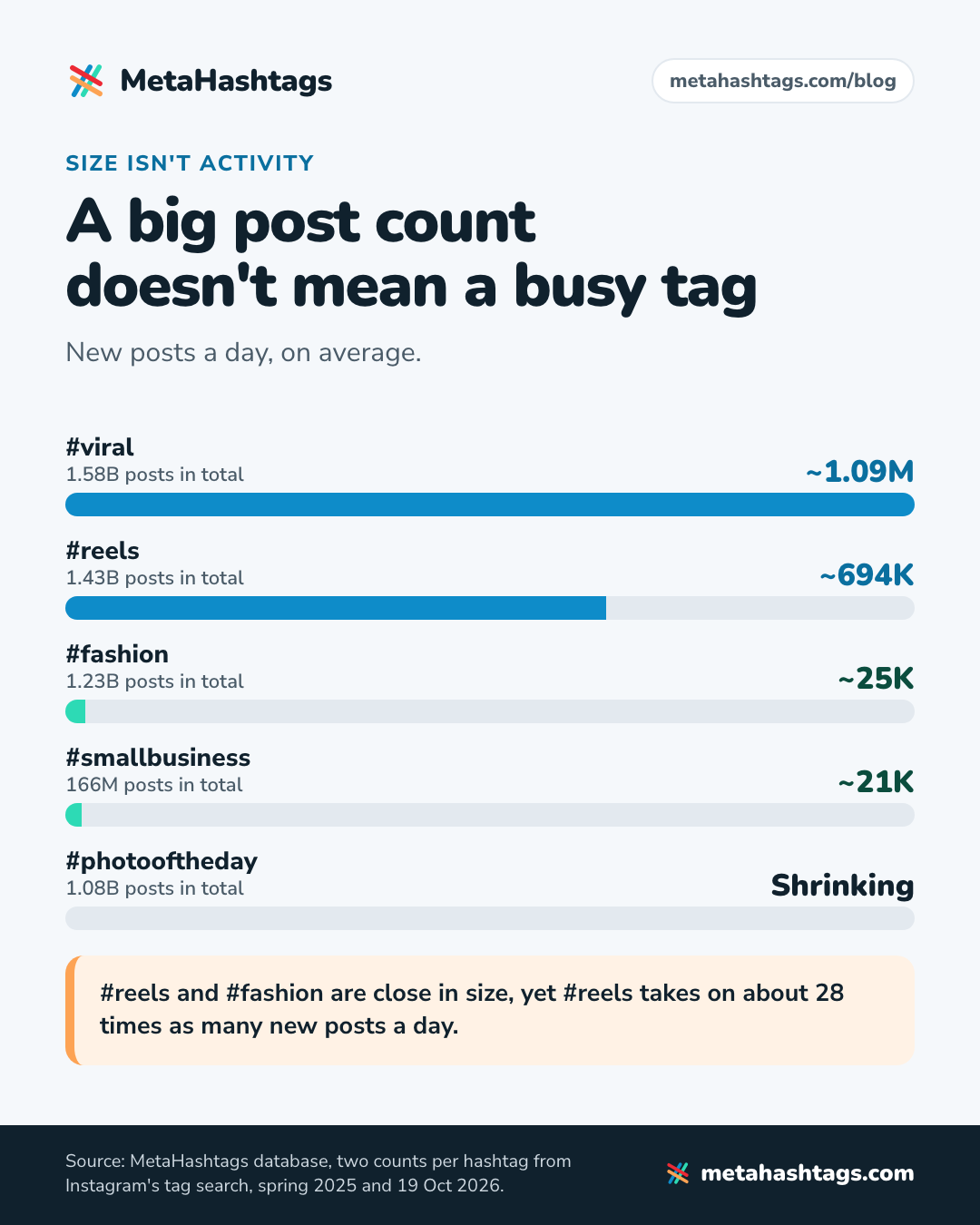
For some big tags we have two snapshots of the count, about 18 months apart, which shows how fast they’re growing (MetaHashtags data, spring 2025 to October 19, 2026):
| Hashtag | Posts now | Growth since spring 2025 | New posts a day (avg.) |
|---|---|---|---|
| #viral | 1.58B | +60% | ~1.09M |
| #reels | 1.43B | +39% | ~694K |
| #explorepage | 793M | +33% | ~370K |
| #fashion | 1.23B | +1.2% | ~25K |
| #smallbusiness | 166M | +7% | ~21K |
| #photooftheday | 1.08B | −1% | Shrinking |
#reels and #fashion are close in size, yet #reels is taking on about 28 times as many new posts a day. #smallbusiness, about a seventh the size of #fashion, gains almost as many (about 21,000 a day against 25,000). And #photooftheday has about 10.8 million fewer posts than in May 2025, probably from deleted posts and tags edited out of captions; Instagram doesn’t explain it. These are averages between two snapshots, not daily measurements.
Size isn’t competition either
How hard a tag is to get seen on depends on what’s arriving now and how it performs. Instagram’s Help Center lists what decides the order of posts in hashtag search results:
When the post was shared. How others engage with the post. If content meets our Recommendation Guidelines.
On #viral, your post lands among roughly a million others posted the same day, and engagement is one of the things that decides which of them get seen. #sourdoughfocaccia has 75,076 posts in total, ever. Very different queue.
The number that stopped at 2,147,483,647
Instagram’s tag search returns exactly 2,147,483,647 posts for #love. That’s the largest number a signed 32-bit integer can hold, a common ceiling in software. #love’s real count has gone past what the counter can show, so nobody outside Instagram knows the true figure; we display it as 2.1B+. #instagood is next, at 2,025,328,379, about 122 million posts short of the same wall.
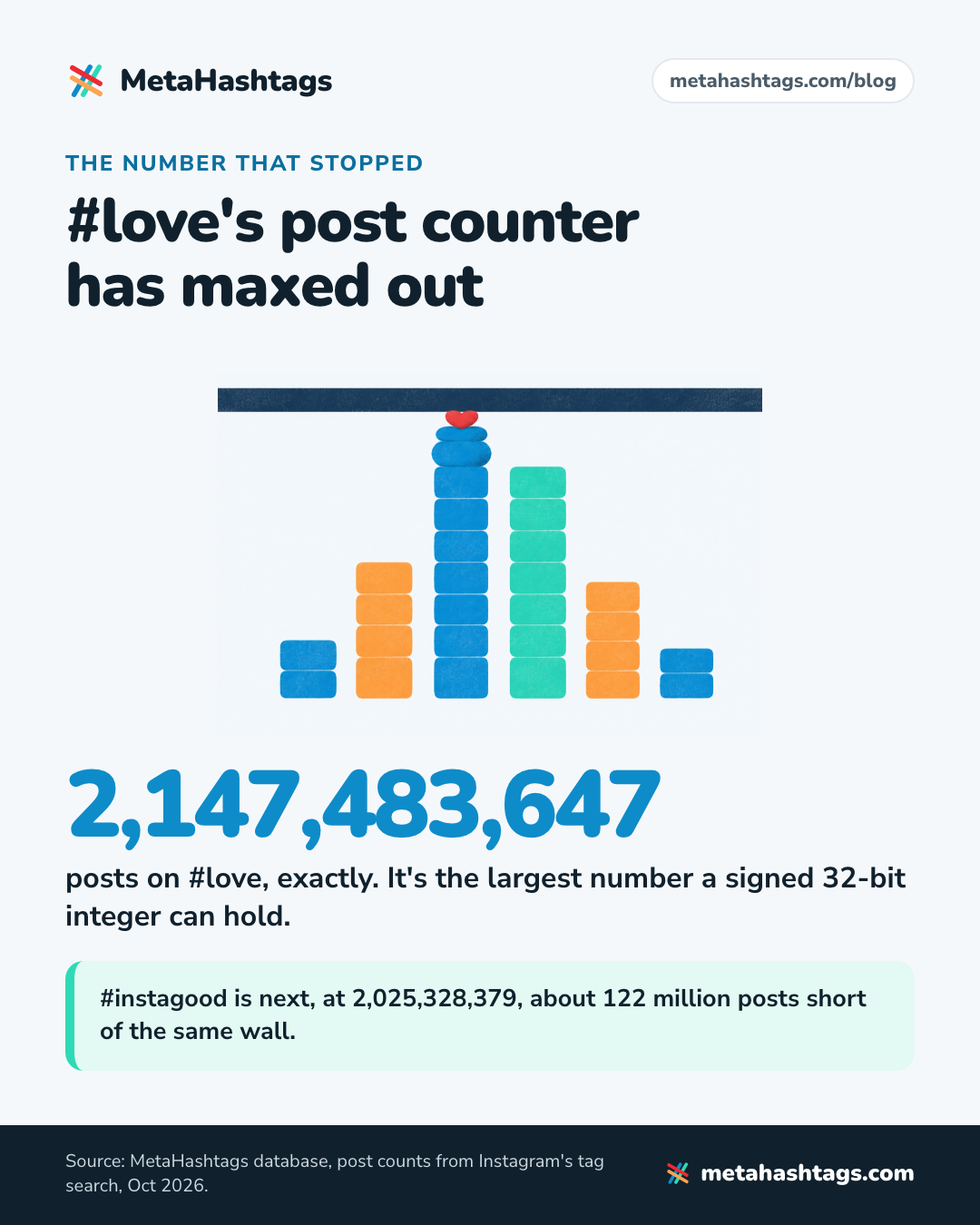
At that size the exact number has stopped meaning much anyway. On a tag with two billion posts, one more is a rounding error.
Hashtag size tiers: how big is big?
Raw counts are hard to compare in your head, so sort tags into tiers. These are the tiers our generator labels, and how the 553,656 hashtags in our database split across them (MetaHashtags data, October 2026; counts last checked between May 2024 and October 2026, the most-searched tags most often):
| Tier | Posts | Hashtags in our database | Example |
|---|---|---|---|
| Huge | 100M+ | 319 (0.06%) | #nailart (168.0M) |
| Big | 10M–100M | 4,731 (0.9%) | #nailartist (27.0M) |
| Mid | 500K–10M | 67,548 (12.2%) | #sourdough (9.3M) |
| Niche | 10K–500K | 243,732 (44.0%) | #sourdoughbaker (150.4K) |
| Tiny | Under 10K | 236,131 (42.6%) | #homeworkoutmom (8.2K) |
| Zero | No posts | 1,195 (0.2%) | (none) |
The hashtags everyone knows are a tiny elite: 319 of 553,656 have 100 million posts or more. And 479,863, about 87%, have fewer than 500,000. Most of what you’ll find when you research a topic is Niche or smaller, which is where the specific tags live.
Other guides publish their own ranges (Later’s April 2026 guide calls 10K–200K the sweet spot; Tailwind’s older advice was to stay under 500K) without showing data behind them. In fairness, our tiers are size labels, not a performance promise either. I haven’t seen anyone publish data showing that tags of a given size get you more reach.
How I’d use the tiers with five slots
My take, for a small or mid-size account: one Big or Mid tag that names the topic, then three or four Niche or Tiny tags that describe this exact post, its place or its community. I’d skip the Huge tier. The busiest of those take hundreds of thousands of new posts a day, and when Instagram announced the cap in December 2025 it recommended “fewer (up to 5) more targeted hashtags, rather than many generic ones” (Social Media Today).
Say you shoot weddings in London. A sensible five, with live counts from October 19, 2026:
- #weddingphotographer: 33,970,573 posts (Big), the one broad tag.
- #weddingceremony: 4,465,609 (Mid), if it’s a ceremony shot.
- #weddingphotographersociety: 271,632 (Niche).
- #weddingphotographeruk: 83,602 (Niche).
- #weddingphotographerlondon: 55,428 (Niche), the one a couple planning a London wedding might actually type.
Shoot in Cornwall instead and #weddingphotographercornwall has 9,394 posts. That’s Tiny, and I’d still use it, because nothing on the list describes the post more exactly.
How to tell if a hashtag is active, crowded or restricted
Is anyone still using it?
Open the hashtag page and look at the dates on several posts, not just the first few, since Instagram mixes recency with engagement when ordering them. If the newest you can find are weeks or months old, the tag has gone quiet.
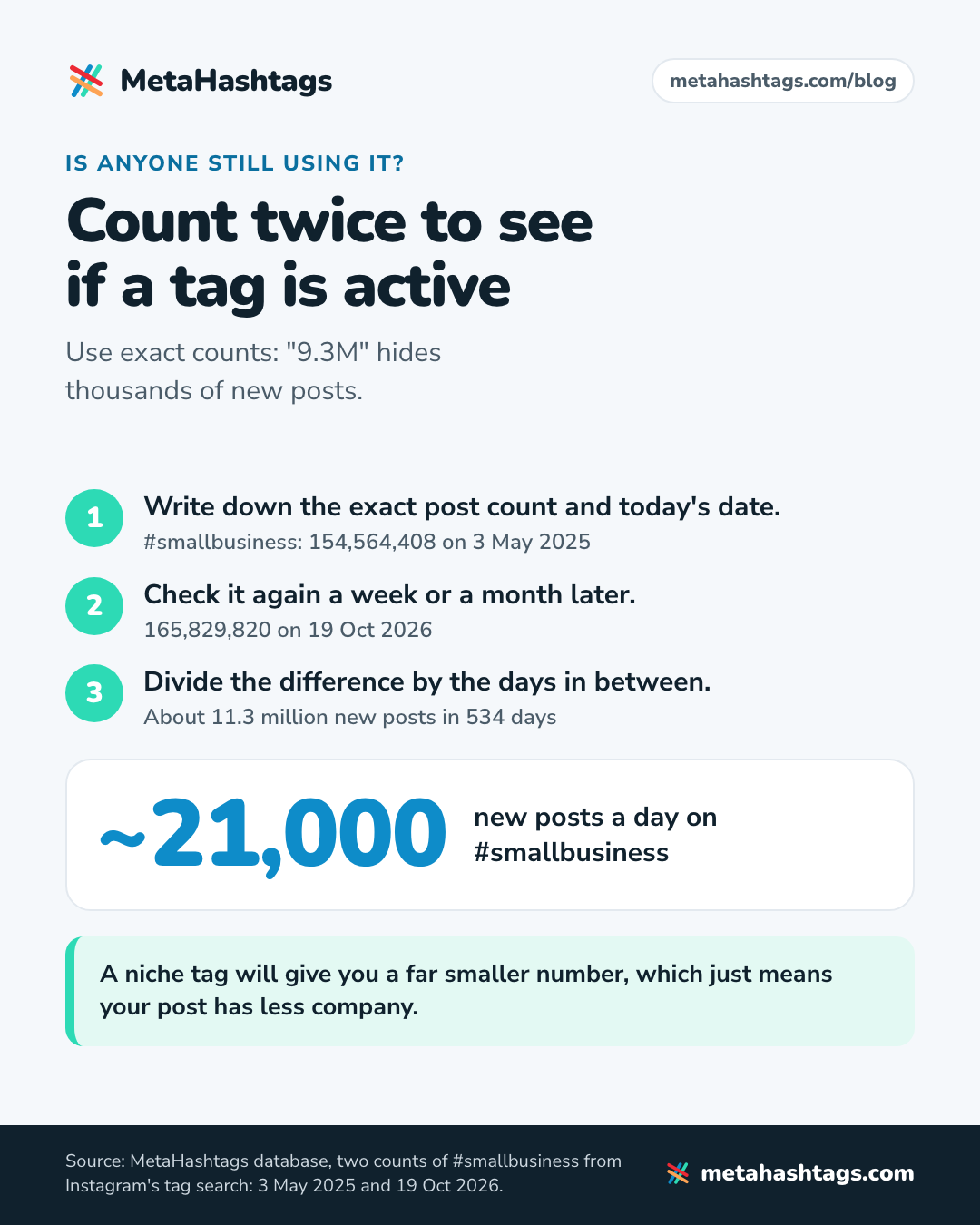
For a firmer answer, count twice:
- Write down the tag’s exact post count and today’s date.
- Check it again a week or a month later.
- Divide the difference by the number of days in between.
That’s how I got the growth figures above. #smallbusiness went from 154,564,408 posts on May 3, 2025 to 165,829,820 on October 19, 2026: about 11.3 million new posts in 534 days, or roughly 21,000 a day. A niche tag will give you a far smaller number, which just means your post has less company. Use exact counts; “9.3M” hides thousands of new posts.
Who’s winning it?
Look at the top posts on the hashtag page. If they come from accounts many times your size, with engagement you rarely get, a new post from you is unlikely to sit beside them for long. That’s a judgment call rather than a rule, and it’s the main reason I point small accounts toward Niche tags.
Is it restricted?
Instagram’s Help Center is direct about this: “Hashtags on Instagram may not be searchable if the text or the content associated with the hashtag consistently do not follow our Terms of Use or Community Standards.” It also says Instagram reviews these tags “periodically and may make a hashtag searchable again” (Instagram Help Center).
So the first test is simple: search for the tag, and if it doesn’t come up, leave it out. The second is a checker. Our generator flags tags on our list of 1,861 hashtags Instagram has restricted, which includes everyday words like #desk, #pushups, #kansas and #todayimwearing. Instagram restricts and un-restricts tags without announcing it, so check before you post rather than trusting a list from years ago.
Is it the tag you think it is?
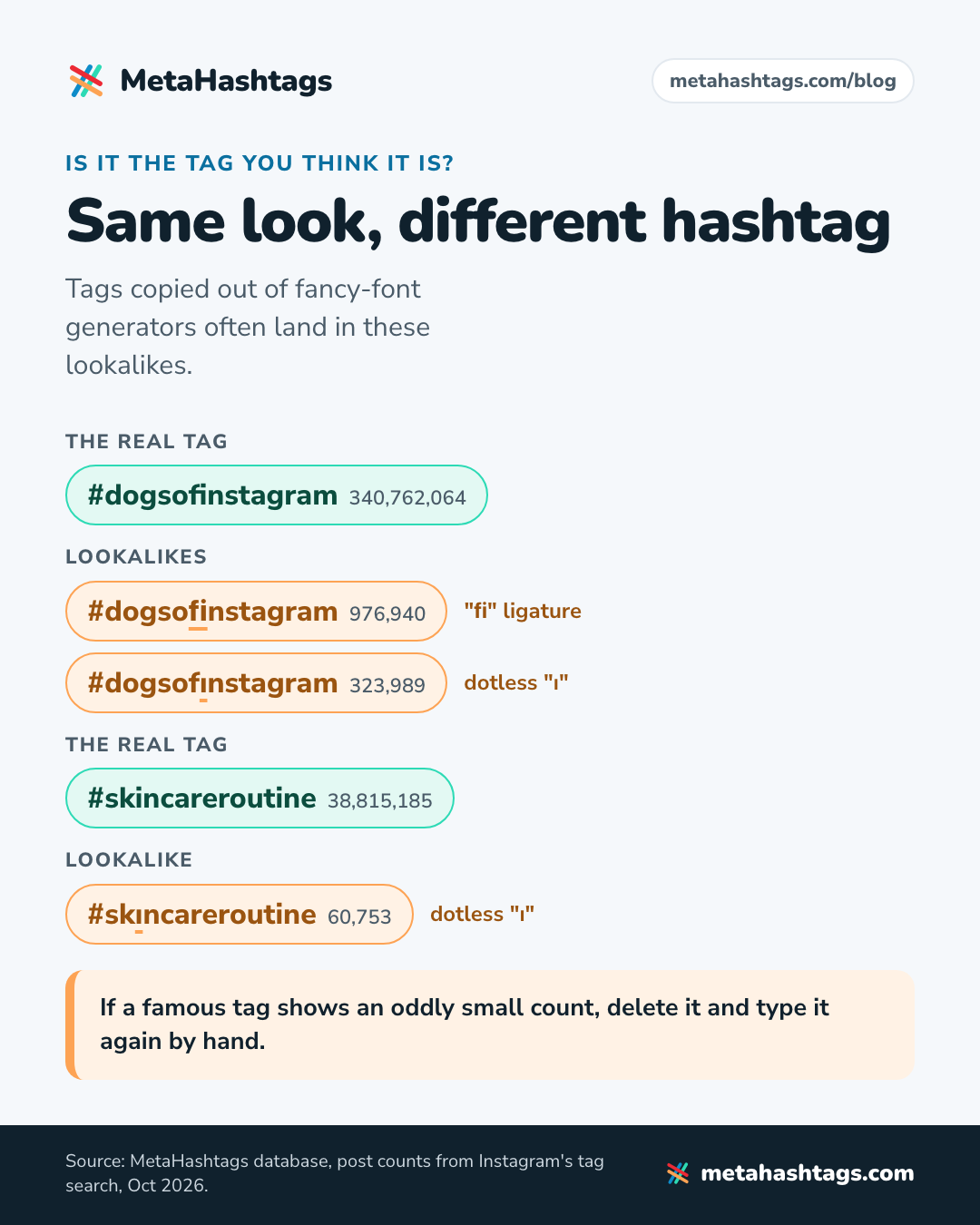
This one catches people out. #dogsofinstagram has 340,762,064 posts. #dogsofinstagram, typed with the “fi” ligature character, looks the same but is a different hashtag with 976,940 posts. #dogsofınstagram, with a dotless “ı”, has 323,989. There’s even a #skıncareroutine with 60,753 posts next to the real #skincareroutine and its 38,815,185. Tags copied out of fancy-font generators often land in these lookalikes. If a famous tag shows an oddly small count, delete it and type it again by hand.
Does hashtag popularity still matter in 2026?
Less than it used to, and for different reasons.
You only get five now (“You can use up to 5 tags on a post,” says the Help Center), down from 30 before Instagram’s December 2025 change. There’s more on that in our guide to how many hashtags to use.
Instagram has also said hashtags aren’t a reach lever. Adam Mosseri said in February 2025 that they “don’t work” to increase reach, and in May 2025 called them “a great way to let people know what a post is about and connect posts” (both relayed by Social Media Today).
Popularity does still feed into search. Mosseri’s 2021 explainer on Instagram search puts the text you type first and your own activity second, then adds: “When there are a lot of potential results, we also look at popularity signals. These include the number of clicks, likes, shares and follows for a particular account, hashtag or place.” It predates the end of hashtag follows, but it’s the clearest explanation from Instagram I could find.
So popularity is a filter, not a goal. Use the count to rule out tags too big to matter or too empty to be found, then choose among the rest by how precisely they describe the post. Plenty of people do the opposite: since spring 2025, #viral has grown 60%, #reels 39% and #explorepage 33%, and those are exactly the generic tags Instagram’s advice is aimed at. For the rest of the rules, see how to use hashtags on Instagram in 2026.
Hashtag popularity checkers: what each kind of tool tells you
“Hashtag popularity checker” covers three quite different kinds of tool.
Post count checkers
These show how big a tag is, usually with related suggestions. Ours is one; others include StarNgage, Influencer Marketing Hub’s free hashtag tool and browser extensions such as HashtagHunt. I haven’t tested those for accuracy, so I won’t vouch for their numbers. With any checker, compare one tag against Instagram by hand and look for when the count was fetched.
Trackers for your own hashtags
Analytics and scheduling apps such as Metricool and Later report on the hashtags you’ve used on your own posts; Metricool says its tracker covers only those. They’re good for testing your own sets over time, which I walk through in our guide to hashtag analytics.
Social listening platforms
Brand24, Keyhole, Talkwalker and Sprout Social are built for brands tracking mentions and campaigns across networks, and they’re priced for marketing teams. Brand24’s cheapest plan was $199 a month on annual billing ($249 month to month) when I checked its pricing page in October 2026. If all you want to know is whether #sourdoughscoring deserves a slot, that’s a lot of money for a post count.
Why no tool can show you a hashtag’s reach
Before you pay for “hashtag reach” figures: Meta’s official API for hashtag search lets an app “query a maximum of 30 unique hashtags on behalf of an Instagram Business or Creator Account within a rolling, 7 day period,” and its documentation lists no performance metrics for hashtags. Instagram also doesn’t document any way to see how many of your views came from hashtags. So a reach number for someone else’s hashtag is an estimate, or it came from somewhere other than Meta’s official API.
A 10-minute popularity check before you post
- Write down 10 to 15 candidate hashtags. If you’re short of ideas, start with these ways to find hashtags worth testing.
- Get exact counts for all of them in one sitting, in our generator or by hand, and note the date.
- Sort them into tiers. Cross out anything Huge, and anything that doesn’t describe this post, however popular.
- For any you’re unsure about, open the hashtag page and check the post dates and who’s at the top.
- Search each survivor. Drop any that don’t come up or are flagged as restricted, and retype any famous tag with an oddly small count.
- Pick five: one Big or Mid, the rest Niche or Tiny. Put them in the caption, where Instagram’s Creators blog says they belong if you want to be found in search.
- Every month or two, recheck the tags you use most.
Hashtag popularity: quick answers
How do I check hashtag popularity for Reels?
The same way. Instagram’s tag search returns one count per hashtag, with no separate figure for Reels. Open the hashtag page to see how much of what’s there is video, and look at format tags such as #nailarttutorial (529,034 posts) or #bookstagramreels (227,089).
How do I check how popular my branded hashtag is?
Search it and note the count and the date once a month. It may look smaller than your real usage: posts from private accounts “won’t appear publicly on hashtag pages,” and Instagram doesn’t say whether its count includes them.
Can I see trending hashtags on Instagram?
Not officially. Instagram’s Help Center describes a trending audio list (US only, in the mobile app), but I couldn’t find an official trending hashtags list anywhere in it. And #trending is no guide: it’s an evergreen giant with 1,218,596,854 posts. Our guide to finding trending hashtags has a method for spotting rising tags yourself.
Keep reading
-
 Instagram Hashtags
How Many Hashtags on Instagram in 2026? Five, and How to Pick Them
Instagram now allows five hashtags per post, not 30. What changed, what happens if you add a sixth, what the studies say about using… -
 Instagram Hashtags
How to Use Hashtags on Instagram in 2026 (Now You Only Get Five)
Instagram now allows five hashtags per post. What they still do, where to put them, and how to pick the right five, with live… -
 Instagram Hashtags
Instagram Hashtag Analytics in 2026: What You Can (and Can’t) Measure
Instagram doesn't document a views-from-hashtags number. Here's what Insights and hashtag trackers can really measure, plus a free spreadsheet test you can run.