Do Hashtags Still Work on Instagram in 2026? Yes, but Not for Reach
Hashtags still work on Instagram as labels, not as a reach hack. What Instagram has said, why the studies disagree, and a four-week test for your own account.
Do hashtags still work on Instagram? Yes, but for a smaller job than most guides claim. They tell Instagram and people what a post is about, they put public posts on hashtag pages and in search, and they still hold communities and campaigns together. What they don’t do, according to Instagram’s head, Adam Mosseri, is get you more reach. And since December 2025 you only get five per post.
Short answer: Hashtags still work on Instagram as labels, not as a growth lever. Mosseri has said repeatedly that they don’t increase reach, and the two studies everyone quotes contradict each other and prove little either way. Use up to five specific hashtags in the caption for search and categorization, then put your real effort into the post itself.
A disclosure: MetaHashtags sells a hashtag tool, so you might expect me to call hashtags essential. They aren’t. What I can do is show where they still earn their two minutes, using Instagram’s own statements (linked, which most articles skip), the two studies everyone quotes, and our own data.
Do hashtags increase reach? What Instagram has said
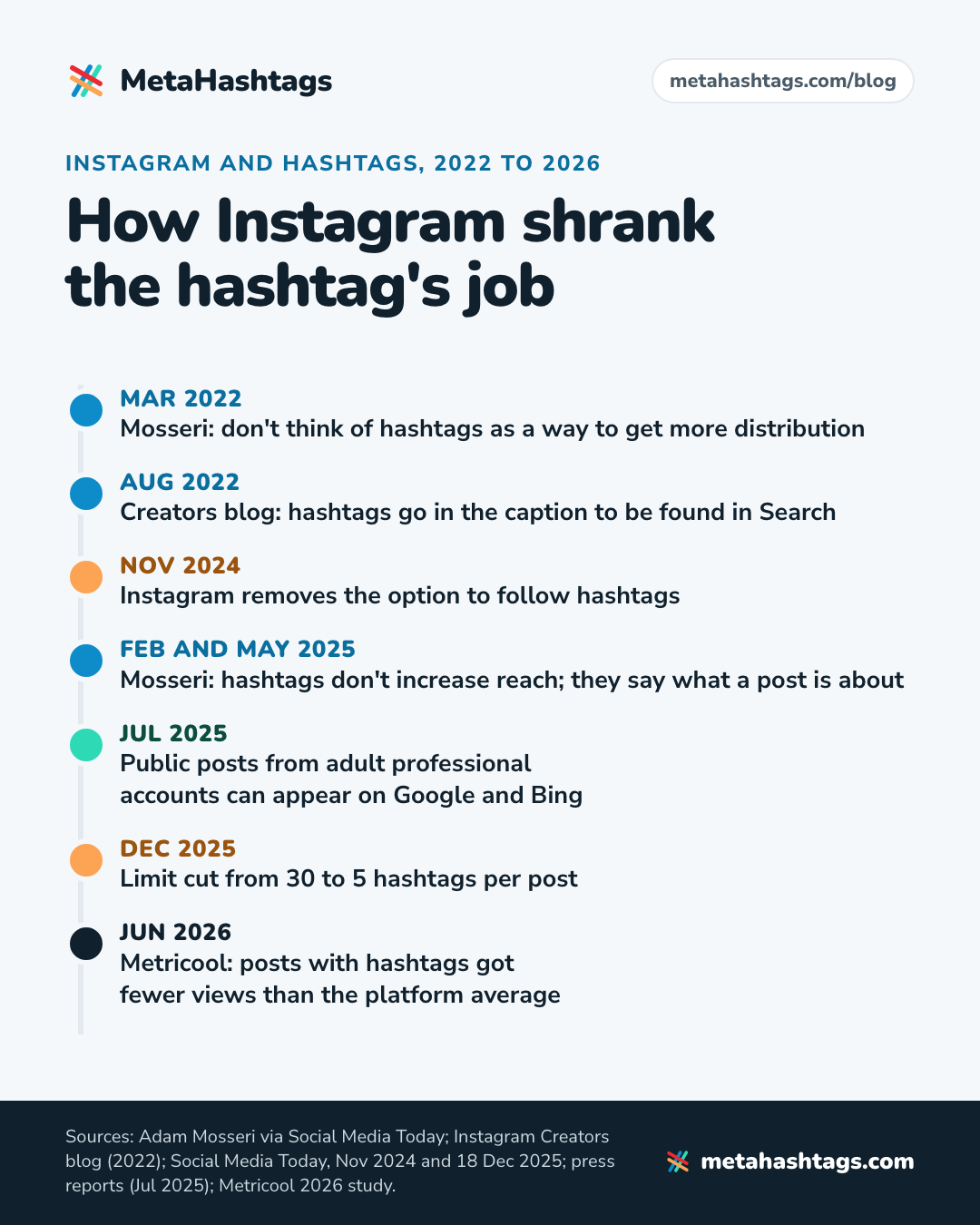
On reach, Instagram has been consistent for years. In February 2025 Mosseri said hashtags “don’t work” as a way to increase reach. In May 2025 he repeated that they don’t improve visibility on Instagram, and added that they’re “a great way to let people know what a post is about and connect posts” (both relayed by Social Media Today). Press coverage says he made the same point in an Instagram Story in March 2022.
Then the rules changed. On December 18, 2025, Instagram announced it would “gradually update the number of hashtags that you can include in a caption for a reel or post to five”, down from 30. Its reason, as quoted by Social Media Today: “We find that using fewer (up to 5) more targeted hashtags, rather than many generic ones, can improve both your content’s performance and people’s experience on Instagram.”
Notice the word “performance”. It compares targeted tags with generic ones, not tags with no tags. My reading: a precise tag helps Instagram file your post in the right drawer; a pile of generic ones is noise. Neither promises more people will see it.
Instagram’s Creators blog adds: “To have your post found in Search, put these keywords and hashtags in the caption, not the comments” (Instagram Creators, 2022). And in November 2024 Instagram told Social Media Today: “We’re removing the ability to follow a hashtag on Instagram” (Social Media Today). That removed the way a hashtag could put your post straight into a stranger’s feed.
The timeline in one table
| When | What happened |
|---|---|
| Mar 2022 | Mosseri: don’t think of hashtags as a way to get more distribution |
| Aug 2022 | Creators blog: keywords and hashtags go in the caption to be found in Search |
| Nov 2024 | Instagram announces it’s removing the option to follow hashtags |
| Feb and May 2025 | Mosseri: hashtags don’t increase reach; they say what a post is about |
| Jul 2025 | Public posts from adult professional accounts can appear on Google and Bing (month per press reports) |
| Dec 2025 | Limit cut from 30 to 5 hashtags per post, rolled out gradually |
| Jun 2026 | Metricool study: posts with hashtags got fewer views than the platform average |
What the data says, and why the studies disagree
Two vendor studies get quoted everywhere. They point in opposite directions, and almost nobody explains why.
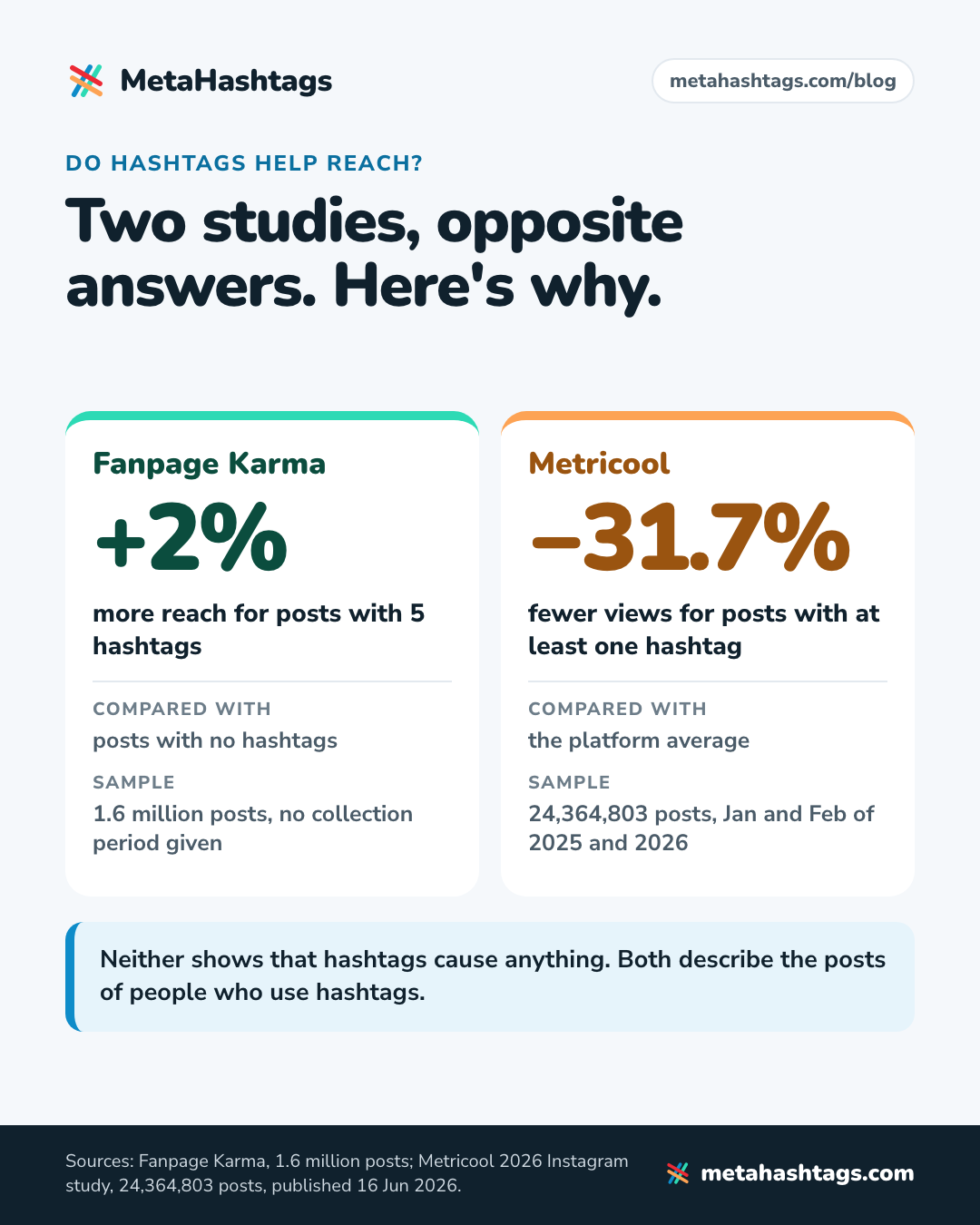
Fanpage Karma: about 2% more reach with five hashtags
The analytics company Fanpage Karma analyzed 1.6 million Instagram posts. Its headline finding: “Posts with 5 hashtags achieve 2% more reach than posts without hashtags.” It also reports that one to three hashtags did slightly worse than none, that more than five lost reach, and that engagement peaked at five.
I’d hold it loosely. The page gives no collection period, no account mix and no definition of reach, and a Fanpage Karma article from February 2024 cites the same 1.6 million figure. So “five is the sweet spot” may well have been measured when 30 were allowed, and I can’t tell from the page. A 2% gap is small enough that the kind of account that uses exactly five tags could explain it alone.
Metricool: 31.7% fewer views for posts with hashtags
Metricool’s 2026 Instagram study, published June 16, 2026, covers 24,364,803 posts from 375,118 accounts, drawn from January and February of 2025 and 2026. Posts using at least one hashtag saw 31.70% fewer views and 33.89% fewer interactions “than the platform average”.
That sounds like a verdict until you check the baseline: the platform average, not similar posts without hashtags. The release doesn’t say how that average was calculated, or whether anything like account size or format was controlled for.
Why both can be true
Neither study shows that hashtags cause anything. Both describe the posts of people who use hashtags, and those people aren’t a random sample.
- The baselines differ. Fanpage Karma compares five tags with zero; Metricool compares any tags with everyone.
- So do the metrics and periods: reach in an undated dataset, versus views in a study covering early 2025 and early 2026.
- The users differ. Metricool’s same study found single-image posts lost 21.96% of their reach year over year. If the accounts that still tag everything post more single images (Metricool doesn’t say), that alone would drag their numbers down.
- It can cut the other way: if big accounts that live on Reels recommendations tend to skip hashtags, the no-hashtag side looks better for reasons unrelated to tags.
My take: together, the studies suggest hashtags have a small effect on reach at most, in either direction, swamped by what gets posted and by whom. That fits what Mosseri says. Neither is a reason to stuff tags in or abandon them.
What hashtags still do on Instagram in 2026
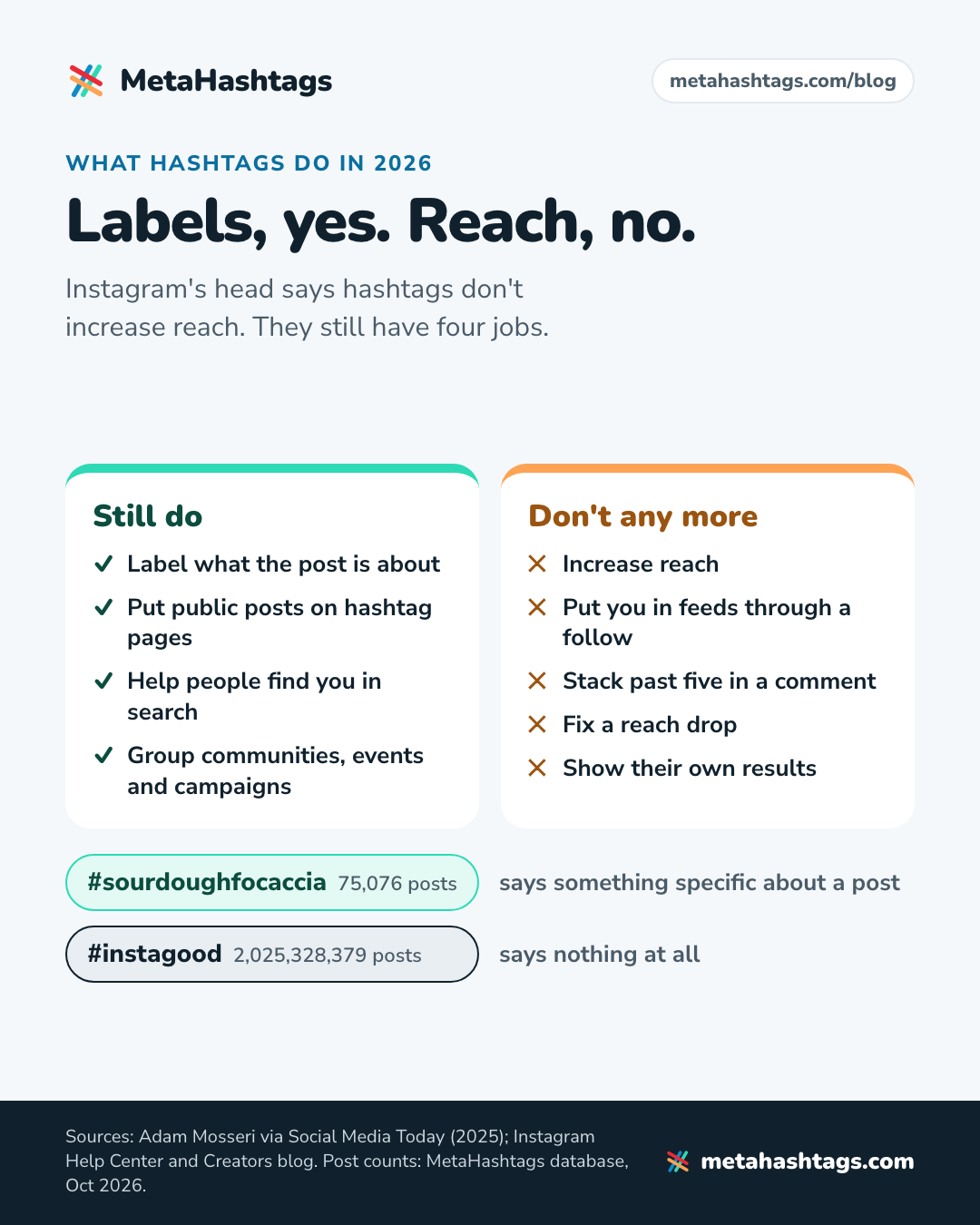
With reach off the table, hashtags still have four useful jobs.
They label the post
This is Mosseri’s “what a post is about” point, and the reason Instagram asked for targeted tags over generic ones. #sourdoughfocaccia (75,076 posts) says something specific about a post. #instagood (2,025,328,379 posts) says nothing at all.
They put the post on hashtag pages
From the Help Center: “If you have a public account and add hashtags to a post, the post will be visible on the corresponding hashtag page.” Private accounts’ posts don’t appear there. To sort those pages, Instagram lists three factors (How posts appear on hashtag search results): “When the post was shared.” “How others engage with the post.” “If content meets our Recommendation Guidelines.” Recency is one of them, so on a giant tag newer posts bury yours fast. On a small tag, far fewer new posts arrive to push it down.
They help people find you in search
The Creators blog puts it plainly: “Search results are matched by text, so make sure you’re including relevant keywords.” Hashtags are part of that text, which is why they belong in the caption. Captions also travel beyond the app now that public posts from adult professional accounts can appear in Google; I’ve covered how Instagram search and Google indexing work separately.
They group communities, events and campaigns
Community tags such as #bookstagram (129,145,066 posts) or #sourdoughclub (578,960) gather posts from people who are into one thing. A branded or event tag collects the public posts made under it, which makes it useful for contests, user-generated content and recurring series. Since following hashtags is gone, though, drop any “follow our hashtag” call to action and ask people to follow the account.
What hashtags don’t do any more
- Increase reach, by Instagram’s own account.
- Put you in anyone’s feed through a follow. That option went in late 2024.
- Stack. Five in the caption plus 25 in the first comment fails, because a comment with more than five tags won’t post.
- Fix a reach drop. If your numbers fell off a cliff, check if your account can be recommended (here’s what people call a shadowban and how to check for one). Adding more tags never repairs anything.
- Show their own results. Instagram doesn’t document a way to see how many views came from your hashtags.
The tags people still pile into
None of this has stopped people tagging everything #viral. Our database had it at 988,579,798 posts on April 27, 2025, and 1,579,428,371 on October 19, 2026. That’s 60% growth in under 18 months: roughly 1.09 million new posts a day, or about 13 a second.
| Hashtag | Posts (Oct 19, 2026) | Added per day (avg) |
|---|---|---|
| #viral | 1,579,428,371 | ~1.09M |
| #reels | 1,431,016,941 | ~694K |
| #explorepage | 792,571,500 | ~370K |
| #smallbusiness | 165,829,820 | ~21K |
| #photooftheday | 1,082,354,419 | Shrinking |
MetaHashtags data, October 2026. Daily figures are averages between two snapshots of each tag (the earlier one from spring 2025). #photooftheday lost about 10.8 million posts in that time, most likely to deleted posts and removed tags.
The engagement-bait tags are growing fastest, cap or no cap, and that’s the problem. A post tagged #viral lands on a page taking about a million new posts a day, sorted partly by recency, so it’s buried within minutes. My advice: skip #viral, #explorepage and #reels. They tell Instagram nothing about your post.
Who still gets the most out of hashtags
Our database holds 553,656 hashtags with an Instagram post count. Only 319 have 100 million posts or more, and about 87% have fewer than 500,000. The tags that still do something for an ordinary account live in that long tail.
Say you’re a wedding photographer in London. #weddingphotographer has 33,970,573 posts. #weddingphotographerlondon has 55,428. A couple planning a London wedding who taps the second one sees a much shorter, local list, and your post can be on it.
Hashtags tend to pay off for local businesses (a place name in the tag matches how people search), hobby communities with their own tags, and brands or events collecting posts in one place. I’d add small accounts: hashtag pages and search are among the few ways strangers find them. Hashtags matter least for accounts already growing through Reels recommendations, and for memes and personal posts nobody searches for. Give those thirty seconds and move on.
What matters more than hashtags now
- Caption keywords. Search matches text, so write what someone would type: “sourdough focaccia recipe”, rather than “Sunday bake”.
- Your name field, username and bio. The same Creators blog post recommends relevant keywords there too.
- The post itself. In January 2025 Mosseri reportedly named watch time, likes per reach and sends per reach as the top ranking signals. None involves hashtags.
- Alt text and on-screen text. Instagram hasn’t confirmed either as a search signal in anything I could find. They’re cheap, so add them, but claims that they “boost SEO” are guesswork.
How to use hashtags now: a two-minute routine
The full playbook is in how to use hashtags on Instagram under the new rules. The short version:
- Write the caption first, in plain words someone would search for.
- Pick up to five hashtags that describe this particular post. A mix I like: one broad topic tag, two or three niche ones, and one local, community or branded tag.
- Check each tag’s size, and make sure none is restricted.
- Put them in the caption, not a comment.
- Change them from post to post, so every post carries labels that fit.
For a sourdough focaccia post, with live counts from our generator: #sourdough (9,262,289 posts), #sourdoughbaking (1,153,446), #sourdoughclub (578,960), #sourdoughfocaccia (75,076), plus the bakery’s own tag. If five honest tags don’t exist, use fewer; a forced fifth is usually the generic one Instagram told you to drop. The fine print on the cap is in how many hashtags Instagram allows per post.
Do hashtags still work on Instagram for your account? A four-week test
Studies describe other people’s accounts. This test is about yours, and it beats guessing.
- Pick one format you post often (carousels, say), and keep topics and posting times as similar as you can.
- Alternate posts: A gets five specific hashtags, B gets none. Aim for at least six of each over four weeks; with fewer, one lucky post decides the result.
- Seven days after each post, note its views, its accounts engaged (Instagram splits these into followers and non-followers) and its profile activity.
- Compare the medians of A and B, not the averages. One post that takes off can drag an average anywhere.
- Look hardest at non-follower numbers. That’s where any hashtag effect should show.
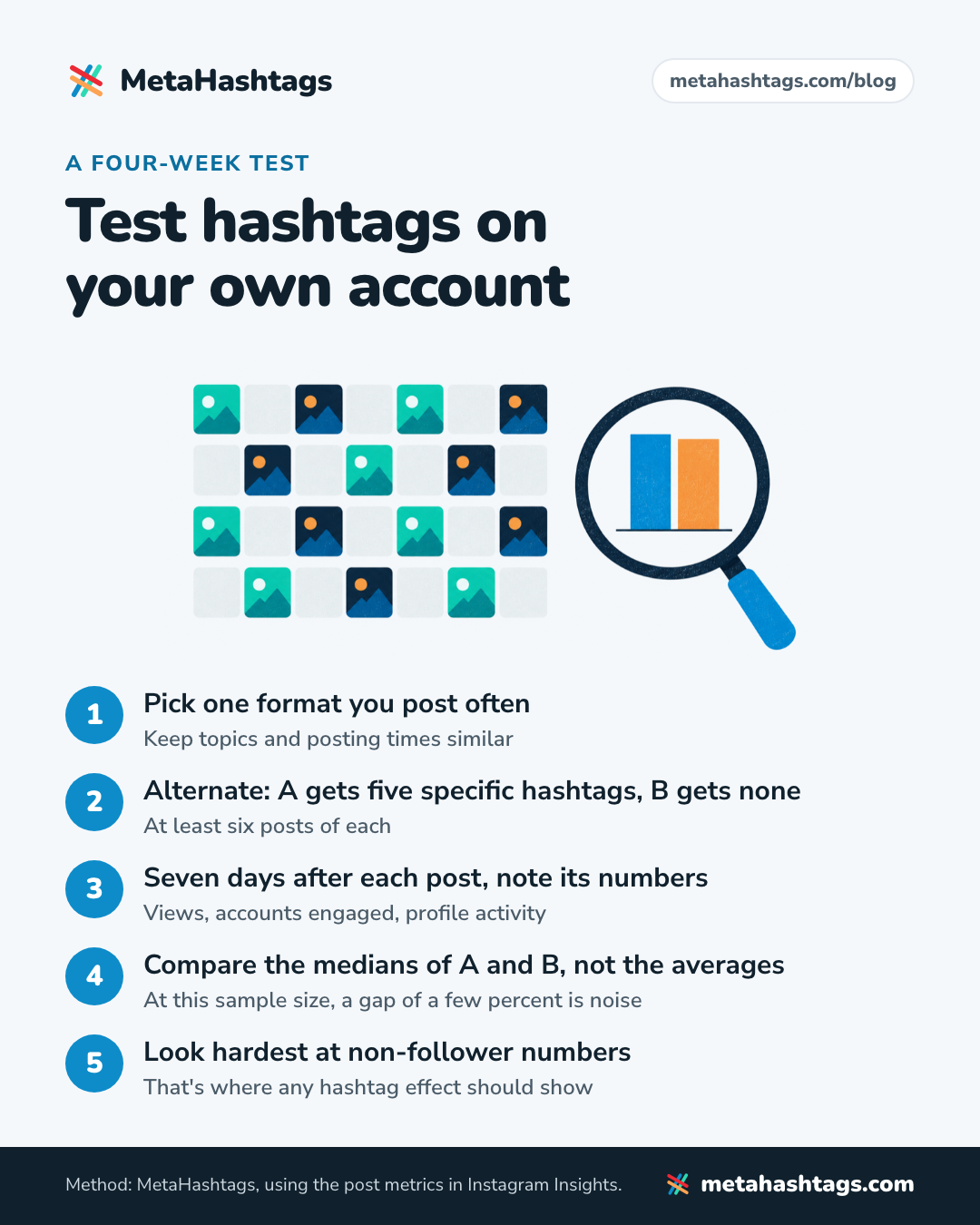
How to read it: at this sample size, a gap of a few percent is noise. If A clearly wins with non-followers, keep tagging. If there’s no real difference, keep five relevant tags anyway (two minutes, and they help search) but stop expecting them to move reach. If B clearly wins, check your tags for restricted ones first. Instagram doesn’t break out views from hashtags, so this only measures the total effect; here’s what Instagram’s analytics can and can’t tell you about hashtags.
FAQ
Are hashtags still relevant on Instagram in 2026?
Yes, as labels for search and hashtag pages, and for grouping communities and campaigns. They aren’t a reach tool, and Instagram says so.
Do hashtags in comments still work?
The Help Center allows them, but a comment with more than five won’t post. For search, Instagram says caption, not comments, so that’s where I’d put them.
Can you still follow a hashtag on Instagram?
No. Instagram announced its removal in November 2024. You can still search a hashtag, or tap one to see its page.
Do hashtags work on Reels?
In the same limited way, under the same cap: Instagram’s announcement covered “a caption for a reel or post”. Tag what the reel is about; #reels tells Instagram nothing it doesn’t already know.
Should I stop using hashtags?
No. Five specific tags take two minutes and still help people find a post through search and hashtag pages. Just stop treating them as the reason a post did or didn’t take off. Put the time into the post and a caption with real keywords, and run the four-week test if you want your own answer.
Keep reading
-
 Instagram Hashtags
Instagram SEO in 2026: How to Get Found in Search and on Google
How Instagram search actually works, what's confirmed and what's guesswork, why caption keywords matter more under the 5-hashtag cap, and how your posts end… -
 Instagram Hashtags
Instagram Shadowban in 2026: How to Check, Fix and Avoid It
Instagram says silent hiding isn't its intention, but it does stop recommending some posts and accounts. How to check yours in Account Status, what… -
 Instagram Hashtags
How to Use Hashtags on Instagram in 2026 (Now You Only Get Five)
Instagram now allows five hashtags per post. What they still do, where to put them, and how to pick the right five, with live…